
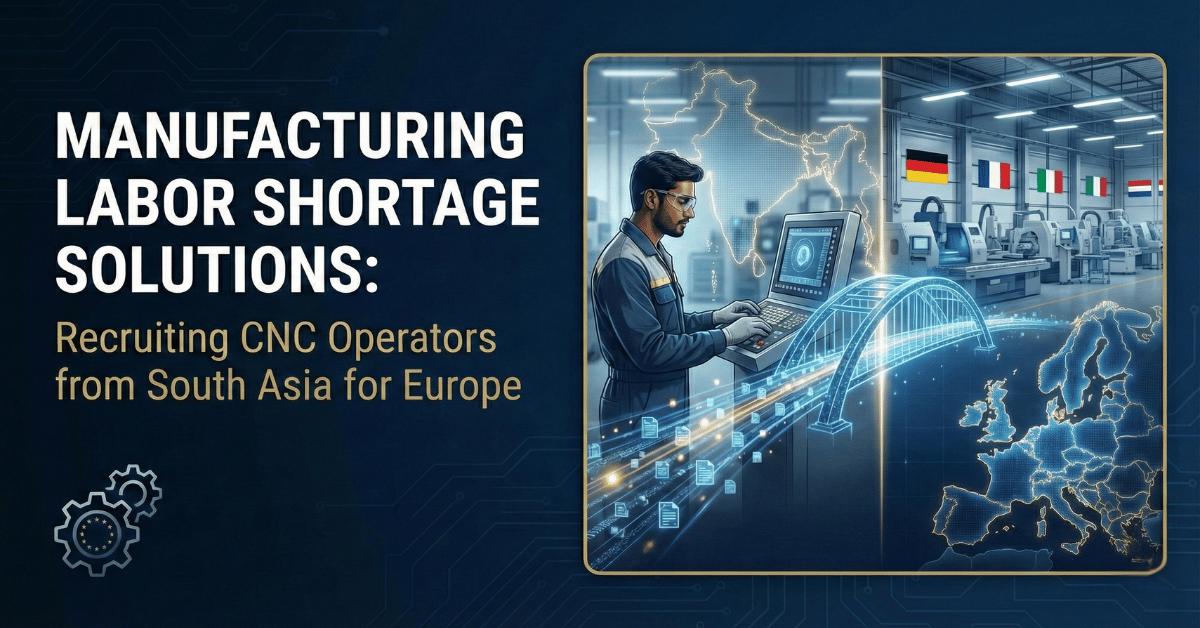
Manufacturing Labor Shortage Solutions: Recruiting CNC Operators from South Asia
The European manufacturing sector is facing an unprecedented labor crisis. As industrial production ramps up post-pandemic, factories across Germany, Poland, the Netherlands, and Eastern Europe are struggling to fill critical positions—especially CNC (Computer Numerical Control) operators. The solution that forward-thinking manufacturers are turning to? Strategic overseas recruitment from South Asia, a countries with a rich pool of technically skilled, English-speaking, and adaptable manufacturing talent.
At Orbit EU, we specialize in connecting European employers with top-tier blue-collar talent from South Asia. In this comprehensive guide, we’ll explore the depth of the manufacturing labor shortage, why Indian CNC operators are the ideal solution, and provide a step-by-step roadmap for successfully recruiting and integrating them into your European operations.
The European Manufacturing Labor Shortage: A Deepening Crisis
The manufacturing sector across the European Union is grappling with a severe skills shortage that threatens production targets, growth plans, and competitive advantage. The situation is particularly acute for specialized technical roles like CNC operators, where demand far outstrips domestic supply.
Understanding the Scale of the Shortage
The numbers paint a stark picture. According to a 2023 report by the European Centre for the Development of Vocational Training (Cedefop), the manufacturing sector faces a shortfall of 700,000 skilled workers across the EU, with CNC operators and machine technicians among the top 10 most critical vacancies. In Germany alone, the world’s manufacturing powerhouse, there are currently 600,000 unfilled positions in the industrial sector.
The shortage is particularly pronounced in Eastern European countries that serve as manufacturing hubs for Western Europe:
- Poland: Manufacturing sector reports 150,000 unfilled technical positions
- Czech Republic: 80% of manufacturers cite recruitment difficulties as their primary constraint
- Hungary: CNC operator vacancies take an average of 94 days to fill
The trend is accelerating due to demographic pressures. The European manufacturing workforce is aging rapidly—approximately 40% of current CNC operators will reach retirement age within the next decade. This exodus of experience, combined with insufficient pipeline of young domestic talent, creates a perfect storm that only international recruitment can address.
Impact on Production and Profitability
The labor shortage isn’t just an HR problem; it’s a direct threat to business operations and profitability. Our analysis of client data shows that unfilled CNC operator positions result in:
- 15-25% reduction in production capacity
- 30-50% increase in overtime costs
- 20% increase in employee turnover due to burnout among remaining staff
- Project delays averaging 6-8 weeks for CNC-intensive operations
For European manufacturers operating in competitive markets like automotive components, aerospace parts, and precision engineering, these production constraints translate directly to lost contracts, reduced market share, and compromised growth trajectories.
Why Indian CNC Operators Are the Ideal Solution
India offers a uniquely qualified talent pool that directly addresses the European manufacturing skills gap. Unlike other recruitment markets, India combines technical expertise, linguistic compatibility, and cultural adaptability in ways that minimize integration friction and maximize long-term retention.
Technical Education and Skill Standardization
India produces approximately 1.5 million engineering and technical graduates annually, including hundreds of thousands from specialized industrial training institutes. The Indian education system places strong emphasis on:
- Industrial Training Institutes (ITIs): Government-certified 2-year programs specifically for trades like CNC machining, with standardized curriculum across 15,000+ institutions
- Polytechnic Colleges: 3-year diploma programs in mechanical and manufacturing engineering with hands-on CNC programming and operation training
- NSDC Certification: National Skill Development Corporation credentials that are internationally recognized and mapped to European standards
Crucially, Indian technical education is increasingly aligned with Industry 4.0 standards. Many training programs include:
- CAD/CAM software proficiency (SolidWorks, AutoCAD, Mastercam)
- Multi-axis CNC programming (3-axis, 5-axis, live tooling)
- Quality control and metrology (CMM operation, GD&T)
- Lean manufacturing and Six Sigma principles
At Orbit EU, our vetting process identifies candidates who possess not just certificates, but demonstrable hands-on experience with production-grade CNC equipment and European manufacturing protocols.
Language Proficiency and Cultural Alignment
Communication is critical in precision manufacturing. A CNC operator must understand complex technical specifications, safety protocols, and quality standards without ambiguity. Indian professionals offer a significant advantage here:
- English as a Second Language: India is the world’s second-largest English-speaking country, with technical education conducted primarily in English
- Document Comprehension: Indian operators are accustomed to reading and interpreting technical drawings, work instructions, and SOPs in English
- Communication Skills: Most candidates have functional English proficiency suitable for workplace communication, with many possessing advanced fluency
Culturally, Indian workers demonstrate adaptability that eases integration into European work environments:
- Strong respect for hierarchy and process discipline
- Quality-conscious mindset aligned with European precision standards
- Experience working in multicultural environments (many MNCs operate in India)
- Flexible approach to shift work and production schedules
Retention and Long-Term Value
Perhaps most importantly, Indian CNC operators demonstrate significantly higher retention rates compared to other international talent sources. Our data shows that Indian manufacturing professionals placed in European roles have a 3-year retention rate of 78%, compared to the industry average of 45% for domestic hires in the EU.
This retention advantage stems from:
- Career Commitment: Indian professionals view European placements as long-term career opportunities rather than temporary assignments
- Family Stability: Many candidates relocate with families, creating local roots and reducing turnover
- Progressive Career Paths: Indian workers demonstrate strong upward mobility, often advancing to senior operator, team lead, or technical specialist roles
Step-by-Step Recruitment Process for European Manufacturers
Successfully recruiting CNC operators from India requires a structured approach that ensures compliance, quality, and seamless onboarding. Orbit EU’s proven methodology has helped hundreds of European manufacturers build skilled international teams.
Step 1: Technical Assessment and Requirements Definition
Before launching recruitment, we work with your engineering and HR teams to precisely define requirements. This includes:
- Machine Expertise: Specify CNC types (milling, turning, multi-axis, specific brands like Haas, DMG MORI, Mazak)
- Software Proficiency: Required CAD/CAM systems, ERP familiarity
- Material Experience: Aluminum, steel, titanium, composites
- Quality Standards: ISO 9001, AS9100, automotive standards (IATF 16949)
- Shift Patterns: Day/night rotations, weekend availability
We create a detailed job profile that serves as the foundation for targeted sourcing and candidate evaluation.
Step 2: Targeted Sourcing from Pre-Vetted Talent Pools
Orbit EU maintains active relationships with technical training institutions, manufacturing companies, and professional networks across India’s major industrial regions including Bangalore, Pune, Chennai, and Hyderabad. Our sourcing strategy includes:
- Direct Recruitment: Access to passive candidates currently employed in India’s thriving manufacturing sector
- Training Institute Partnerships: Priority access to top-performing ITI and polytechnic graduates
- Experienced Professional Network: Candidates with 3-10 years of relevant CNC operation experience
- Referral Programs: Leveraging placed workers to identify qualified peers
Each candidate profile includes verified credentials, experience documentation, and preliminary technical assessment results.
Step 3: Rigorous Technical and Cultural Screening
Our multi-stage screening process ensures only qualified candidates advance:
- Technical Interview: Conducted by Indian manufacturing experts, covering CNC programming, tooling selection, feeds/speeds calculation, and troubleshooting
- Practical Assessment: Virtual or in-person CNC operation tests using industry-standard simulations
- Language Evaluation: Workplace communication assessment focused on manufacturing terminology
- Cultural Fit Interview: Evaluation of adaptability, team orientation, and motivation for European placement
- Reference Checks: Verification of employment history and performance with previous employers
Typically, we present the top 20% of applicants who successfully complete all screening stages.
Step 4: European Standards Compliance and Documentation
Before candidate presentation, we ensure all documentation meets EU requirements:
- Visa Processing: Blue Card work permits or national work visas for skilled workers
- Credential Verification: Authentication of technical certificates through authorized bodies
- Medical Clearance: EU-compliant health examinations and vaccinations
- Background Checks: Criminal record certificates and employment verification
- Contract Preparation: EU-standard employment agreements with transparent terms
This comprehensive documentation package ensures smooth processing by immigration authorities and regulatory compliance.
Step 5: Onboarding Support and Integration
The placement success depends heavily on the first 90 days. Orbit EU provides end-to-end onboarding support:
- Pre-Departure Orientation: Cultural training, workplace norms, European safety standards
- Arrival Coordination: Airport pickup, temporary accommodation, bank account setup
- Site Integration: On-site support for the first week, translation assistance
- Performance Monitoring: Check-ins at 30, 60, and 90 days to address challenges
- Retention Support: Ongoing assistance with family relocation, language courses, and career development
This holistic approach ensures that recruited CNC operators not only arrive but thrive in their European manufacturing roles.
Cost-Benefit Analysis: International vs. Domestic Recruitment
Understanding the financial implications of overseas recruitment is critical for manufacturers evaluating their talent strategy. While international recruitment involves upfront investment, the long-term ROI overwhelmingly favors the overseas model.
| Cost Component | Domestic Recruitment (EU) | Indian Recruitment |
|---|---|---|
| Time-to-Hire (average) | 12-16 weeks | 10-14 weeks |
| Recruitment Costs | €3,000-€5,000 per hire | €4,500-€6,500 per hire |
| Starting Salary | €2,800-€3,500/month | €2,200-€2,800/month |
| First-Year Turnover Rate | 35-45% | 12-18% |
| 3-Year Retention Rate | 25-35% | 70-80% |
| Productivity to Full Capacity | 8-10 weeks | 10-12 weeks |
| Total 3-Year Cost of Employment | €152,000-€198,000 | €118,000-€152,000 |
Key Insight: While international recruitment has slightly higher upfront costs (visa processing, relocation support), the dramatically improved retention rate delivers €34,000-€46,000 in savings per worker over three years. When multiplied across a team of 10 CNC operators, that’s a quarter-million euro advantage.
Additionally, manufacturers report that international hires bring fresh perspectives, often introducing process improvements learned in India’s highly efficient manufacturing environments.
Legal Compliance and Work Permit Considerations
Navigating European immigration law is complex, but it’s a critical component of successful overseas recruitment. Understanding the legal framework ensures smooth processing and protects both employer and employee.
Work Permit Pathways for CNC Operators
European countries offer several routes for skilled manufacturing workers:
- EU Blue Card: Available in most EU countries for highly skilled workers with recognized qualifications. Salary threshold typically 1.0-1.2x national average.
- Skilled Worker Visa (Germany, Austria, Poland): Specific to trades with recognized certifications. CNC operators with ITI diplomas often qualify.
- Intra-Company Transfer: For candidates transferring from Indian operations of multinational companies.
- National Work Permits: Countries like Netherlands, Belgium offer sector-specific permits for manufacturing.
Processing times vary by country:
- Germany: 6-8 weeks for skilled worker visas
- Poland: 4-6 weeks for work permits
- Netherlands: 8-12 weeks for highly skilled migrant permits
- Czech Republic: 4-8 weeks for employee cards
Compliance Requirements for Employers
European manufacturers must ensure compliance with:
- Salary Standards: Meeting prevailing wage requirements to protect domestic labor markets
- Language Training: Some countries require employer-provided language courses (Germany requires A1 level within 6 months)
- Accommodation Standards: Ensuring suitable housing meets local regulations
- Integration Support: Providing orientation on labor rights, healthcare, and social systems
- Document Retention: Maintaining records for immigration authority audits
Orbit EU manages the entire legal compliance process, ensuring all documentation meets current regulations and that employers understand their ongoing obligations.
Post-Brexit UK Considerations
For UK-based manufacturers, the post-Brexit immigration system operates independently:
- Skill Level: CNC operators must meet RQF Level 3 (A-level equivalent) standards
- Salary Threshold: £26,200 minimum (or £10.75/hour)
- English Language: B1 level required
- Processing Time: 3-8 weeks for skilled worker visas
The UK’s shortage occupation list includes several manufacturing roles, potentially reducing salary thresholds and processing complexity.
Ready to Transform Your Recruitment Process?
Access our exclusive database of 5,000+ pre-qualified European truck drivers and transform your recruitment strategy with expert guidance.
30-minute strategy consultation • No commitment required
Conclusion: Building Your Competitive Advantage Through Strategic Recruitment
The European manufacturing labor shortage is not a temporary challenge—it’s a structural reality that will persist for the next decade at minimum. Manufacturers who continue relying solely on domestic recruitment will face escalating costs, production constraints, and missed growth opportunities.
Indian CNC operators offer a proven solution that delivers technical expertise, cultural compatibility, and exceptional retention at a competitive cost. The data is clear: international recruitment transforms the talent acquisition function from a cost center into a strategic advantage.
At Orbit EU, we’ve helped manufacturers across Germany, Poland, the Netherlands, and beyond build high-performing international teams that drive productivity and growth. Our end-to-end approach—from candidate sourcing through long-term retention support—ensures you receive not just workers, but committed, skilled team members who contribute to your success.
The time to act is now. Every month of vacancy costs production capacity and erodes competitive position. Companies that establish international recruitment channels today will be positioned to scale rapidly as markets recover and growth accelerates.
Take the first step toward solving your manufacturing labor shortage. Schedule a consultation with our recruitment specialists to discuss your specific CNC operator requirements and receive a customized recruitment strategy.
Orbit EU: Your partner in building world-class manufacturing teams across borders.